Your stock is trading at €110. Your call lets you buy it for €100. Exercising sounds like an easy €10 win. But if you can sell the call for €16.04, exercising and immediately selling the shares recovers €6.04 less per share. For a contract covering 100 shares, that is about €604 of value given up.
An American option gives you the right to exercise early. It does not make early exercise the best way to realise a gain. The decision is a comparison between immediate exercise, selling the option and keeping its remaining rights.
We will reproduce the numbers, explain why non-dividend-paying calls are a special case, and show why dividends and puts change the answer. The prices below are illustrative model values, not live market quotes.
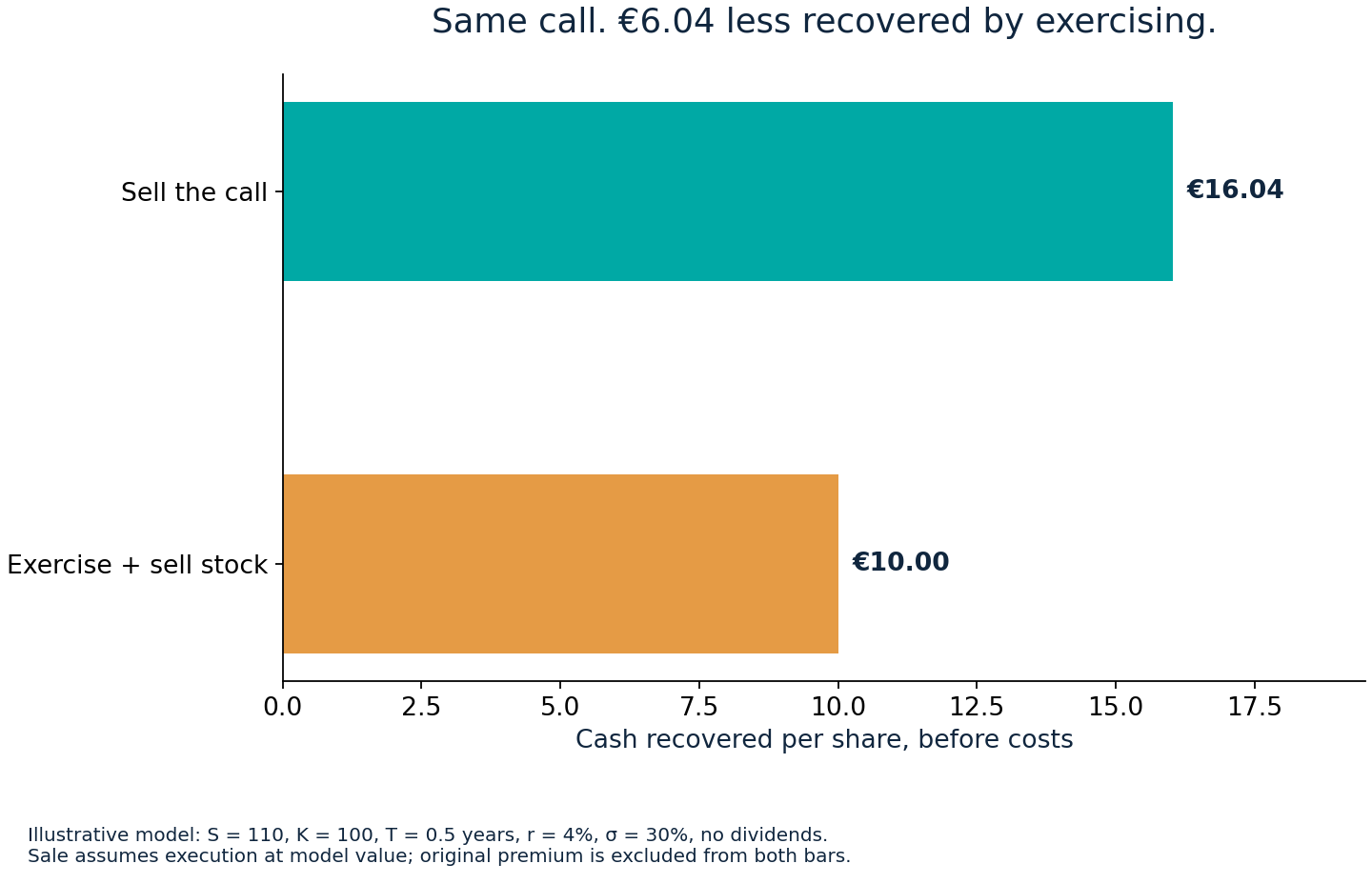
Selling an option is different from exercising it
Selling a call closes your position in the option. Exercising a physically settled call uses the contract: you pay the strike and receive the underlying shares. To turn that exercise into cash, you must then sell those shares. Keeping the shares is a different position, with different funding and downside exposure.
American and European describe exercise rights, not geography. An American-style contract permits exercise before expiry under its contract rules; a European-style contract permits exercise only at expiry. Both can be traded before expiry when a market is available.
A €16.04 call with only €10 of intrinsic value
Take a non-dividend-paying stock at 110, strike 100, six months remaining, volatility 30% and a continuously compounded annual rate of 4%. Under Black–Scholes, the call value is approximately 16.03625 per share. In this frictionless setting, its American and European values coincide.

Here  is intrinsic value and
 is the value above immediate exercise, often called extrinsic or time value. The following cash flows assume sale at model value, no bid–ask spread, no taxes and no fees.
| Action | Cash flow now, per share |
|---|---|
| Sell the call | Receive €16.04 |
| Exercise and sell the stock | Pay €100, receive €110: net €10 |
| Exercise and keep the stock | Pay €100; hold a share worth €110 |
| Sell the call and buy the stock | Receive €16.04, pay €110: net outlay €93.96 |
Even if your goal is to own the stock, selling the call and buying the stock uses €6.04 less cash than exercising, under those execution assumptions. Both routes leave you with one share.
These proceeds are not the profit on the original trade. If you previously paid €6 for the call, selling it now produces about €10.04 profit, while exercising and selling the shares produces €4, before financing and costs. The earlier premium matters for total P&L; it is common to both choices and does not change their €6.04 difference.
Why keeping the right can be worth more than using it
An unexercised call lets you benefit from a future rise without forcing you to buy the stock if it falls. Exercise removes that choice. It also brings forward payment of the strike: cash paid today is no longer available to earn interest until expiry.
For a non-dividend-paying stock, European put–call parity gives the following identity, where  and
 are European prices and
 is the remaining time:

For an in-the-money call with  , both terms on the right are non-negative. With
 and
 , the financing term is strictly positive. An American call is worth at least its European counterpart, so immediate exercise cannot improve on retaining the option in this setting. At zero rates, indifference can occur in degenerate cases.
This argument requires no dividends before expiry and the usual frictionless funding and trading assumptions. It is not a universal rule for negative rates, hard-to-borrow stocks or markets with material execution constraints. See our put–call parity guide for the replication behind the identity.
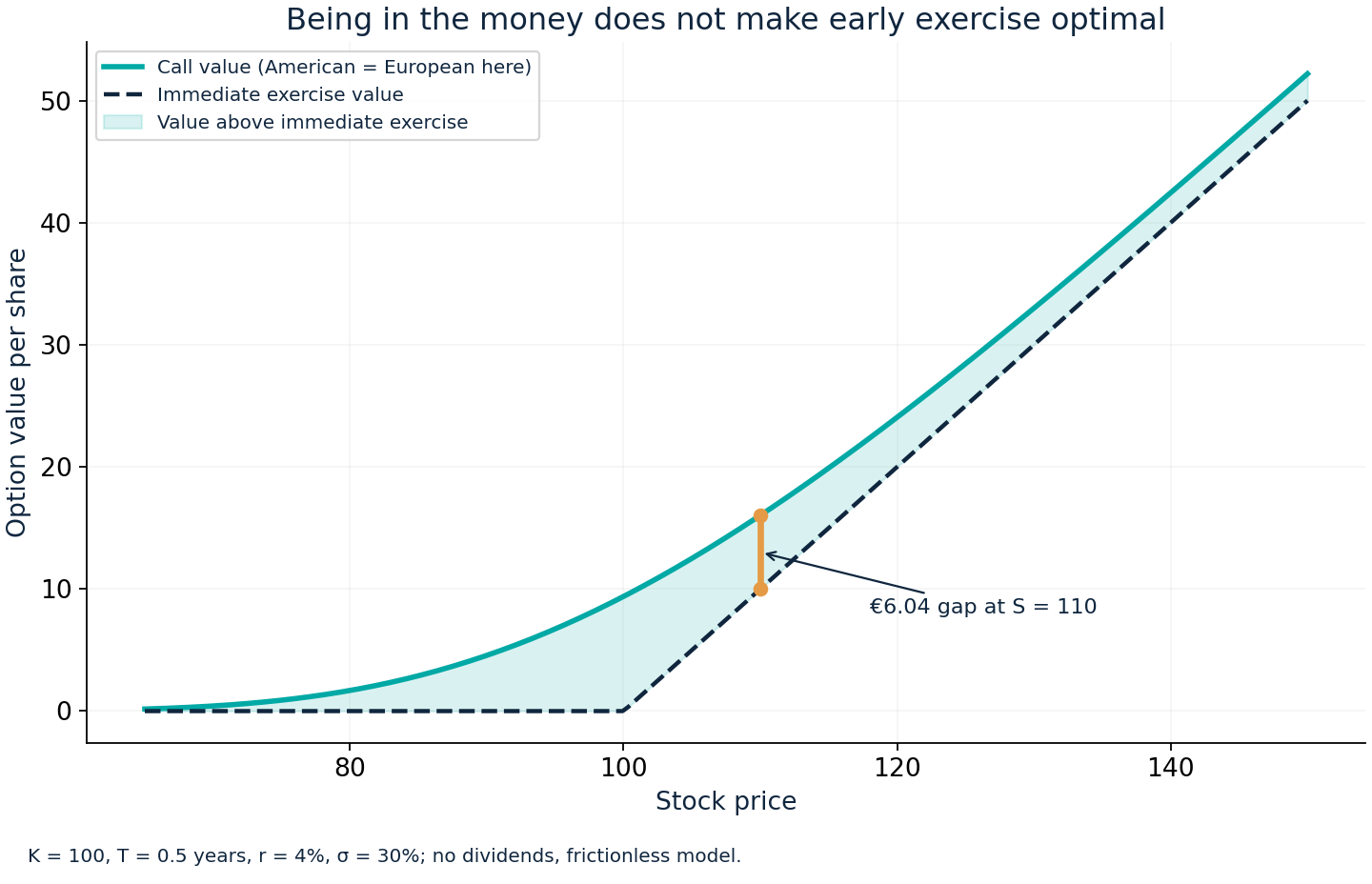
The American exercise decision: immediate value versus continuation
In a pricing tree, work backwards from expiry. At each exercise date, compare immediate payoff with the discounted risk-neutral value of waiting one step and making optimal decisions thereafter:


Here  is continuation value. For a put, replace the exercise payoff with
 . The future values already include later exercise rights. This maximum is the feature missing from a European tree, which simply continues until maturity.
Check the call, then contrast it with a put in Python
The code below uses only the Python standard library. The Cox–Ross–Rubinstein tree has no dividends and permits exercise at its grid dates; it approximates continuous American exercise as the grid is refined. The call is checked against Black–Scholes, and against the same tree without early exercise.
from math import exp, log, sqrt
from statistics import NormalDist

def bs_call(S, K, T, r, sigma):
    N = NormalDist().cdf
    d1 = (log(S / K) + (r + 0.5 * sigma**2) * T) / (sigma * sqrt(T))
    d2 = d1 - sigma * sqrt(T)
    return S * N(d1) - K * exp(-r * T) * N(d2)

def crr(S, K, T, r, sigma, n=400, put=False, american=False):
    # No dividends. Exercise is available at tree dates only.
    dt = T / n
    u = exp(sigma * sqrt(dt))
    d = 1 / u
    p = (exp(r * dt) - d) / (u - d)
    if not 0 < p < 1:
        raise ValueError("Increase n: invalid risk-neutral probability")
    sign = -1 if put else 1
    def payoff(s):
        return max(sign * (s - K), 0.0)
    values = [payoff(S * u**j * d**(n-j)) for j in range(n+1)]
    for i in range(n-1, -1, -1):
        for j in range(i+1):
            hold = exp(-r * dt) * ((1-p)*values[j] + p*values[j+1])
            exercise = payoff(S * u**j * d**(i-j))
            values[j] = max(hold, exercise) if american else hold
    return values[0]

S, K, T, r, sigma = 110.0, 100.0, 0.5, 0.04, 0.30
price = bs_call(S, K, T, r, sigma)
intrinsic = max(S - K, 0)
euro = crr(S, K, T, r, sigma)
amer = crr(S, K, T, r, sigma, american=True)
print(f"Call value: {price:.4f}")
print(f"Intrinsic value: {intrinsic:.4f}")
print(f"Value lost by exercising: {price-intrinsic:.4f}")
print(f"European / American tree: {euro:.4f} / {amer:.4f}")
assert abs(amer - euro) < 1e-8
assert abs(euro - price) < 0.02

# Contrast: a deep ITM put, still with no dividends.
pe = crr(60, 100, 0.25, 0.05, 0.20, put=True)
pa = crr(60, 100, 0.25, 0.05, 0.20, put=True, american=True)
print(f"European / American put: {pe:.4f} / {pa:.4f}")
assert pa >= pe and abs(pa - 40.0) < 1e-8
The call value is approximately 16.0362, with 6.0362 above intrinsic value. The two call trees give the same price to numerical precision. For the contrasting put, spot is 60, strike 100, maturity three months, rate 5% and volatility 20%: the American tree gives 40, its immediate exercise value, while the European value is about 38.76.
A put exercise receives the strike rather than paying it. At positive rates, receiving that cash sooner can outweigh the remaining optionality when the put is sufficiently deep in the money. Therefore, “never exercise early” cannot be transferred from a non-dividend-paying call to a put.
What changes when the stock pays a dividend?
A call holder does not receive the stock dividend merely by owning the call. Exercising before an ex-dividend date can secure the shares and the entitlement, subject to the contract and broker procedures. That benefit can make exercise optimal for some in-the-money American calls.
The dividend is not free money: the stock price normally adjusts down on the ex-dividend date, all else equal. The comparison must include that price change, the strike paid early and the optionality relinquished. A discrete cash dividend also needs a model that actually includes its timing and amount; the no-dividend tree above does not do that.
There is a useful distinction here. In an ideal model, when exercise is optimal, the American value equals intrinsic value because continuation is worth no more. If you can still sell the call for more than intrinsic value after costs, selling it and buying the stock gives the same share ownership at lower net cost than exercise—even just before a dividend. A dividend alone is not a reason to ignore an executable sale price.
Before acting, compare executable cash flows
Use the option bid you can actually obtain, not a theoretical price or a stale last trade. For exercise followed by a stock sale, use the stock bid, subtract the strike and include exercise and trading costs. For selling the call and buying stock, use the stock ask. Wide spreads can materially alter the comparison.
Check the multiplier, settlement method, dividend timetable and your broker’s exercise cut-off. Exercise can create a funded stock position, and short American option positions may be assigned before expiry. The Options Industry Council exercise FAQ explains the distinction between closing a position and exercising, and the role of broker deadlines.
Reproduce the intuition in Options Lab
Open Options Lab, choose a European call, and use spot 110, strike 100, volatility 30%, maturity 0.5 years, rate 4% and dividend yield zero. Compare the model price, approximately 16.04, with the intrinsic value of 10. A European calculator is valid for this particular American-call comparison because early exercise adds no value under these assumptions.
Change spot and maturity to explore the gap between price and intrinsic value. For American puts or calls with discrete dividends, use a model with the appropriate exercise feature rather than treating the European result as the American price. The Python tree above supplies the no-dividend put comparison.
For the foundations of risk-neutral valuation and numerical pricing, explore the Stochastic Calculus module. For another distinction that matters when interpreting an option chain, read why delta is not the probability of profit.
The question to keep
Before exercising, ask: what can I receive by selling the option, and what do I give up by using it? Being in the money establishes an immediate payoff. It does not establish that immediate exercise is the most valuable use of the contract.
Technical references
Pricing and Hedging Derivative Securities: Options Markets develops the no-dividend early-exercise argument. The numerical examples, cash-flow comparisons, charts and Python implementation in this article are our own. Operational details should be checked against the actual contract and broker.
Keep the formulas beside you. Get the free Quant Reference Card for a compact companion to stochastic calculus, pricing models and numerical methods.